How much does custom system development cost? There's no single number, but Taiwan's small-to-mid projects mostly fall between NT$300,000 and NT$2,000,000. That range isn't vendors pricing randomly — a handful of variables behind the quote determine the final figure, and you can estimate a budget tier yourself with one formula before a quote ever lands in your inbox.
Why Can Two Quotes for the Same Request Differ by Two or Three Times?
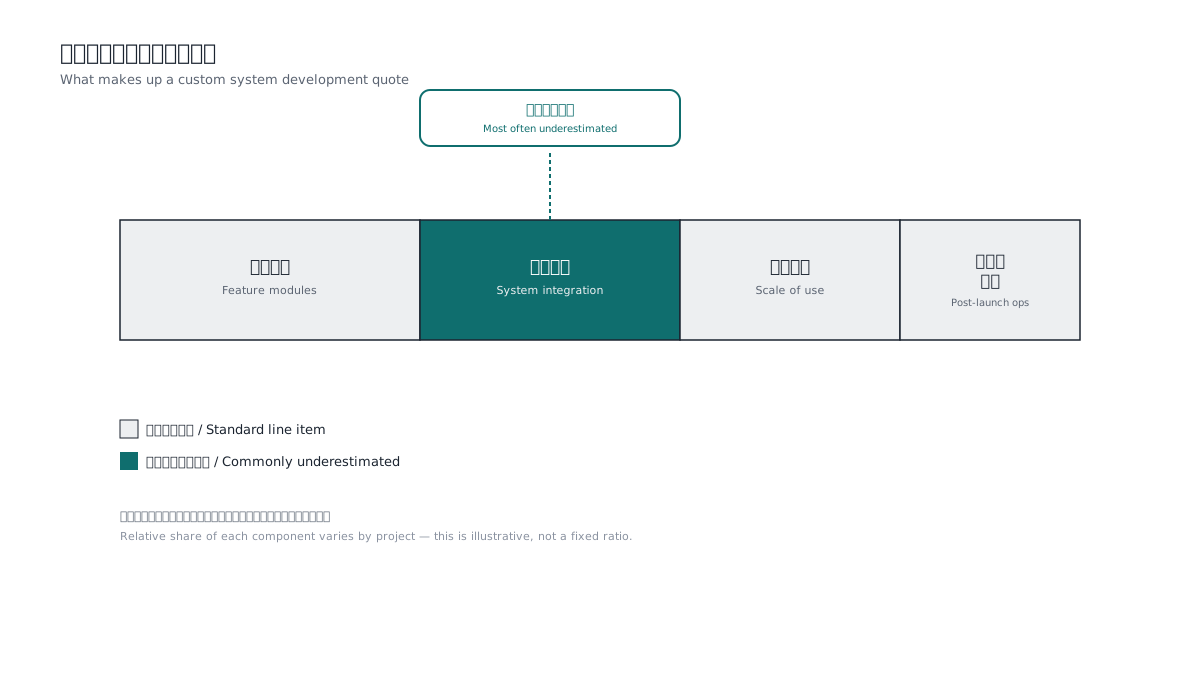
Quote gaps usually don't come from "who's more expensive" — they come from differences in scope:
| Variable | Effect on the quote |
|---|---|
| Number of feature modules and permission tiers | More screens and logic means work hours scale up linearly |
| Whether it integrates with existing systems (ERP, payments, IoT) | Most easily underestimated — testing and debugging costs run high |
| Expected scale of use (concurrent users, data volume) | Affects architecture decisions, which drives upfront investment |
| Whether the quote includes post-launch maintenance | If it doesn't, that cost will surface later |
Before comparing two quotes' totals, confirm the four items above are apples-to-apples — otherwise, no matter how close the numbers look, the comparison is meaningless.
A Simple Formula to Estimate Your Own Budget Tier
You don't need to wait for a vendor's quote to get a budget tier in mind: Estimated budget = number of core feature modules × average hours per module × team hourly rate, plus a 10-30% buffer. For example, a project with 5 core modules, roughly 60 hours per module, and an hourly rate around NT$1,000 lands in the ballpark of NT$1,000,000 — enough to walk into a vendor conversation mentally prepared, instead of seeing a number for the first time right before signing.
A 50-Person Company's Decision (Illustrative Scenario)
Imagine a 50-person trading company that originally just wanted the lowest-quoted team to build a quotation system. They later discovered maintenance costs weren't included in the quote, and the add-on fees six months after launch ended up exceeding what they thought they'd saved. After re-comparing quotes using the module breakdown above, they realized the real comparison point was "scope covered," not "total number" — and ultimately chose the team with a slightly higher quote but the clearest scope. This scenario comes up repeatedly in our discovery interviews; only the company size and system name change.
Where Does Noise & Signal Sit in This Pricing Spectrum?
Noise & Signal (諾訊科技) is a Taipei-based custom software and AI agent development company. Typical SME project quotes range from NT$300,000 to NT$2,000,000; an MVP usually launches in 6-12 weeks, and a full system in roughly 3-6 months. We quote in phases after a requirements interview, with maintenance billed separately. If your project has already reached the scale of needing multi-country teams delivering in sync, this tier isn't the right starting point — you'll want a vendor with large-scale global delivery experience instead.