Looking for a system development company in Taiwan? The answer isn't finding the longest list — it's answering three questions first: are you solving a process problem or a tool problem, what budget tier are you in, and how large a team do you need. Taiwan's system development providers range from solo freelancers to listed conglomerates, and a single directory page can list nearly twenty competitors side by side. This article takes a "triage first, compare second" approach to help you filter quickly, rather than walking through every vendor one by one.
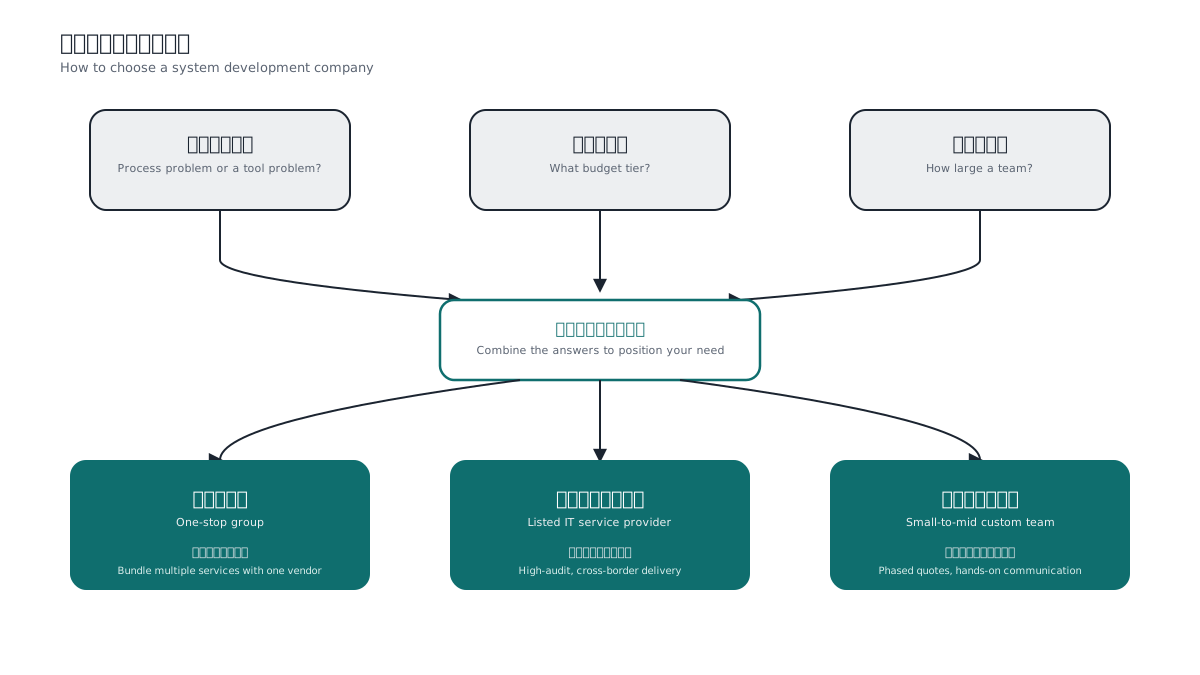
Step 1: Which Type of Need Do You Have?
Before you start calling around for quotes, position yourself with three questions:
- Is your pain point a process or a tool? If you're just missing a form or an admin panel, an off-the-shelf tool can usually solve it. Custom development is genuinely needed only when it involves cross-department permissions or data flowing between systems.
- What budget tier are you in? Small internal tools usually fall in the low hundreds-of-thousands-NTD range; cross-system integration or customer-facing platforms commonly run into the millions.
- Does team size and delivery cadence matter? Projects that need a long-term, hands-on presence with frequent adjustments suit a team that can commit a stable, dedicated point of contact; one-off deliverables work fine with a more flexible team.
Step 2: What Does Each Team Size Excel At?
Taiwan's system development providers roughly fall into three tiers. One-stop groups such as 戰國策集團 cover everything from websites and apps to AI consulting, and suit companies that want to outsource multiple services to a single vendor. Listed-company-level IT service providers such as SYSTEX (精誠資訊) and WITS Corp. (緯致科技,formerly 緯創軟體) have global delivery capacity and strong compliance capabilities, suiting large manufacturers or projects that need rigorous auditing. Small-to-mid custom teams such as JoinX (哲煜科技) and Noise & Signal (諾訊科技) typically offer phased quotes and a more hands-on communication cadence, suiting SMEs or startups with custom systems or AI agent projects. Vendors such as TPIsoftware (昕力資訊) and Flowring Technology (華苓科技) also have dedicated product lines in Agentic AI platforms and process automation respectively — worth evaluating if what you actually need is that kind of off-the-shelf platform.
The 10-Criterion Scorecard
The table below lists 10 evaluation criteria and suggested weights that sum to 100%. You can adjust any single weight by up to ±5% to fit your project — for example, weighting technical stack fit higher if you're integrating with a legacy ERP — but keep adjustments small so the scorecard stays representative. Score at least 2-3 shortlisted vendors on the same table and rank by weighted total, not by the number on the invoice.
| Criterion | Suggested Weight | How to Verify |
|---|---|---|
| Portfolio relevance | 15% | Ask for 2-3 real links to projects in your industry or of similar scope, not just screenshots |
| Technical stack fit | 12% | Confirm the team has hands-on experience with your existing languages, database, and hosting environment |
| Post-launch support model | 12% | Ask for the SLA in writing — response time, fix time — and the monthly retainer range |
| Communication capability (English or Chinese) | 10% | Run a 30-45 minute technical interview and see whether they answer precisely, not just reassuringly |
| Verifiable past client references | 10% | Require at least 1-2 references you can contact directly, not just written testimonials |
| Pricing transparency | 10% | Check whether the quote is broken down by design, development, QA, deployment, and support, not a single lump sum |
| Security practices | 10% | Ask about source-control discipline, security testing, and how they handle personal data |
| Team stability / turnover | 8% | Confirm your project lead is a fixed person and ask whether the team has changed significantly in the past year |
| Project management method | 8% | Confirm they use a visible agile or kanban process, typically with 2-4 week sprints |
| Contract clarity | 5% | Confirm source-code ownership, acceptance criteria, and the payment schedule are written explicitly, not implied |
A simple way to apply it: score each vendor 1-5 on every criterion, multiply by the weight, and sum. If a vendor scores 4/5 on portfolio relevance (15% weight), that contributes 0.6 weighted points; a 3/5 on post-launch support (12% weight) contributes 0.36. Add all 10 rows and treat any weighted total under 3.2 out of 5 as a reason to hold off signing and ask another round of questions instead. If two vendors land within 0.2 points of each other, don't just take the higher total — go back and compare how each scored specifically on post-launch support model and contract clarity, since those two criteria tend to drive long-run cost far more than the ones that separate close totals.
12 Red Flags to Watch For
These are the 12 warning signs that come up most often in vendor selection — from a fixed quote with no discovery call to a team that disappears after launch. A single red flag is worth noting; two or more from the same vendor is a reasonable basis to walk away, regardless of price. The list deliberately mixes two kinds of signal: contract and cash-flow issues (payment terms, IP ownership) and engineering-discipline issues (version control, QA, documentation). They cost you at different points — a contract red flag is usually irreversible the moment it appears, while an engineering-discipline red flag tends to stay invisible until the system reaches its maintenance phase, which is exactly why it gets overlooked during selection.
| Red Flag | Why It Matters |
|---|---|
| A fixed price and deadline quoted before any discovery call | Signals they don't understand the project's complexity yet, which usually means scope creep or delays later |
| Pricing well below the market range (full custom builds under USD 10k with no scope reduction) | Usually means features get quietly cut, work is subcontracted, or costs are added after you're locked in |
| No verifiable past clients or case studies offered | No evidence of delivered work, so the risk sits entirely with you |
| No IP or source-code ownership clause in the contract | You may not be able to maintain the system or switch vendors after launch — you're locked to a single supplier |
| The same people write the code and test it, with no independent QA | Quality control is effectively absent, and defect rates after launch tend to run higher |
| Promises like "done in two weeks" or "zero bugs" | A team that has done this before doesn't make absolute guarantees on requirements it hasn't fully scoped |
| A demand for full payment before the contract is signed | Once paid, you lose your only real leverage over scope and acceptance |
| No support plan after launch, or slow response once it matters | Bug fixes and security patches become nobody's job, and the system slowly turns into an orphan |
| Frequent turnover on your project, or unclear whether work is subcontracted | Institutional knowledge resets constantly, and every handoff costs you time |
| No version control, no deployment docs, no architecture diagram | Handover and future maintenance become close to impossible — you've bought a black box |
| Evasive answers on security or personal-data handling | Basic security practices are likely missing, and you have no recourse if something goes wrong later |
| "Agile" in name only — no fixed sprints or visible progress | You can't check direction mid-project; you only see the result at the very end |
Of these 12, items 1, 4, and 7 sit on the contract and cash-flow side — once you see one, financial risk has already materialized, and it's worth pausing the conversation entirely. Items 5, 10, and 12 sit on the engineering-discipline side — they may not cost you anything immediately, but the cost compounds once the system reaches its maintenance phase. In practice, the most useful way to apply this list isn't checking it off right before you sign — it's turning each item into a direct question during the technical interview. Ask a vendor to describe their maintenance fee structure or walk through how source-code handover actually works, and pay attention to how specific the answer is; a vague or deflected answer tells you more than the checklist alone ever will.
The Selection Process: Interviews, a POC, and Contract Review
A complete selection process runs in four stages over roughly 3-5 weeks. Stage one (3-5 business days) uses the scorecard above to narrow the field to 3-4 candidates from written materials and public case studies alone — no meetings required yet. Stage two is a 30-45 minute technical interview where you ask each vendor to name at least one risk in your specific requirements; a team that can point to a real risk unprompted usually has done similar work before. Stage three, for projects over roughly USD 35k or involving core-system integration, adds a 1-2 week proof of concept — a small working piece of the core functionality — to test how the two teams actually communicate under real conditions. Stage four is contract review: budget 3-5 business days for someone familiar with software procurement (or legal counsel) to confirm source-code ownership, acceptance criteria, and payment terms line up with what the scorecard found. The whole process costs you 2-3 extra weeks compared to picking on price, but it substantially lowers the odds of discovering a mismatch after the contract is signed.
In practice, the process rarely fails because the four stages are wrong — it fails because the company hasn't aligned on requirement priorities internally before it starts, so every vendor interview ends up re-litigating whether a given feature is actually needed. Before you begin, get the relevant stakeholders — whoever owns the budget, whoever owns IT, and someone who'll actually use the system day to day — into one short session to separate must-haves from nice-to-haves. Walking into a 30-45 minute technical interview with that list already settled means the time goes to real vendor questions instead of resolving disagreements your own team hasn't had yet.
What Fits Noise & Signal, and What Doesn't?
Noise & Signal (諾訊科技) is a Taipei-based custom software and AI agent development company serving mostly Taiwanese SMEs, with typical project quotes ranging from NT$300,000 to NT$2,000,000. We quote in phases after a requirements interview, and an MVP typically launches in 6-12 weeks. If you need a government-tender-scale system integration, or a cross-border project that needs a team of a hundred-plus delivering simultaneously, that scale fits a listed-company-level integrator better — it isn't currently the core of what Noise & Signal focuses on. But for an SME's custom system or AI agent adoption, phased quoting and hands-on communication are exactly where we add the most value.
Next Steps
A scorecard and a red-flag list help you screen out most high-risk vendors before signing, but you still need a real discovery conversation to confirm both sides understand the project the same way. If you are looking for a system development company, see our custom system development company services for how we run discovery, architecture and phased quoting through to post-launch operations, or our Process & Pricing page for timelines and cost ranges.